


At Rynat Industries, inclusion means making the workplace more accessible for all employees, whether they have disabilities or not – and it’s had a noticeable improvement on the company’s safety culture.
The Perth-based commercial bathroom specialist has implemented several accessibility features, including communication boards and visual alerts.
Rynat’s commitment to accessibility also centres on clear communication among all employees, which can be achieved without the need for hardware changes.
“Things like the whiteboard that we use for the morning briefing is a great visual aid that complements whenever we’re explaining the tasking for the day, setting out the safety issues that we might be seeing, the sort of daily objectives for the whole team,” says Jay Wasson, Director at Rynat Industries.
Minimal changes bring major benefits
Having two employees with hearing disabilities, clear communication is a top priority to ensure safety for all staff in the workplace, which benefits everyone in the workplace.
“What I can see is good eye contact between them,” Wasson says.
“They don’t talk over their shoulder at each other. When we see them working around on the shop floor, we see mindfulness of each other and safety risks.”
Cultivating the next generation of talent
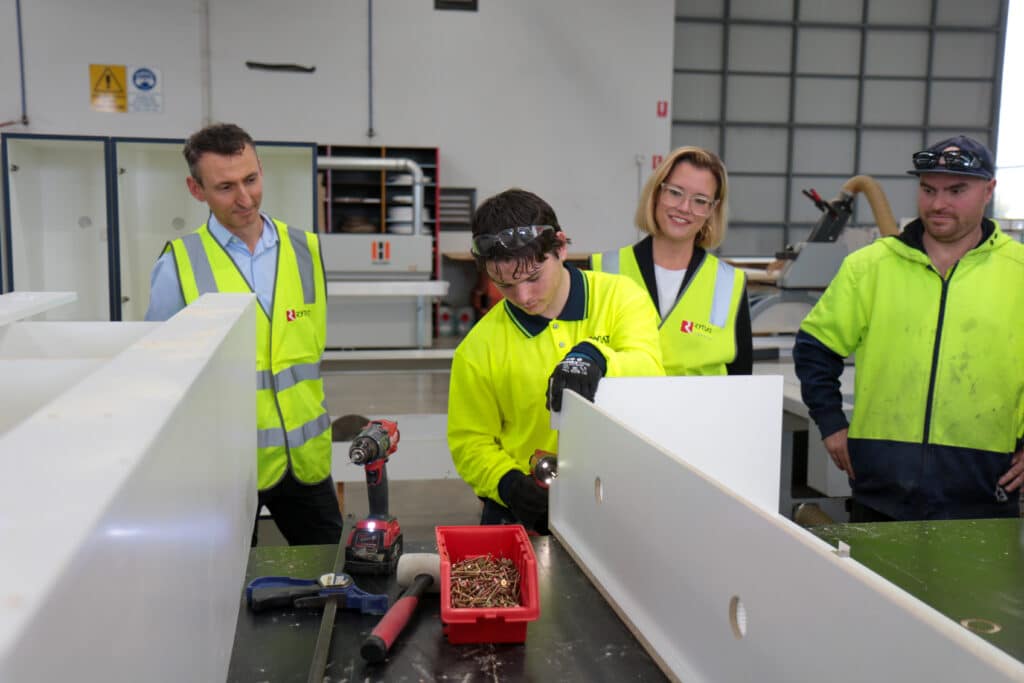
Among the employees of Rynat Industries is Oliver Grant, an 18-year-old apprentice completing a Certificate III in Cabinet Making and Timber Technology.
Grant sees his supervisor, Kyle Smith, a former apprentice who was born deaf, as a role model.
“I want to get my trade certificate. I’m hoping to become a professional cabinet maker, and that will be my career,” says Grant.
He says there have been few barriers so far in the workplace and that assistance from interpreters has helped during “difficult situations”.
Grant encourages others with disabilities to keep trying when seeking employment.
“Don’t give up. Keep going. Just try your best,” he says.
Skills and abilities come first
Despite hiring people with disabilities, Wasson emphasises that the company operates in a “business as usual way” and employees are “given the opportunity because they’re able to do the job”.
“If you’re open to recruiting people who have disabilities, you’re increasing the talent pool from which you’re trying to source new employees,” he says.
“Focus on what skills and experience they bring and what outputs and outlook they can share with the rest of the team, and any employer would want those in their workforce.”
Contact Ability Link to learn more about how CCIWA can help you achieve your business goals through disability employment.