



Long-term business confidence in WA has fallen to its lowest level since the COVID-19 pandemic.
And it’s expected to continue to drop, according to CCIWA Chief Economist Dr Daniel Kiely.
CCIWA’s March Business Confidence Survey, conducted in February, showed 44% of businesses expected economic conditions to improve over the next 12 months – a fall of 24 percentage points since December.
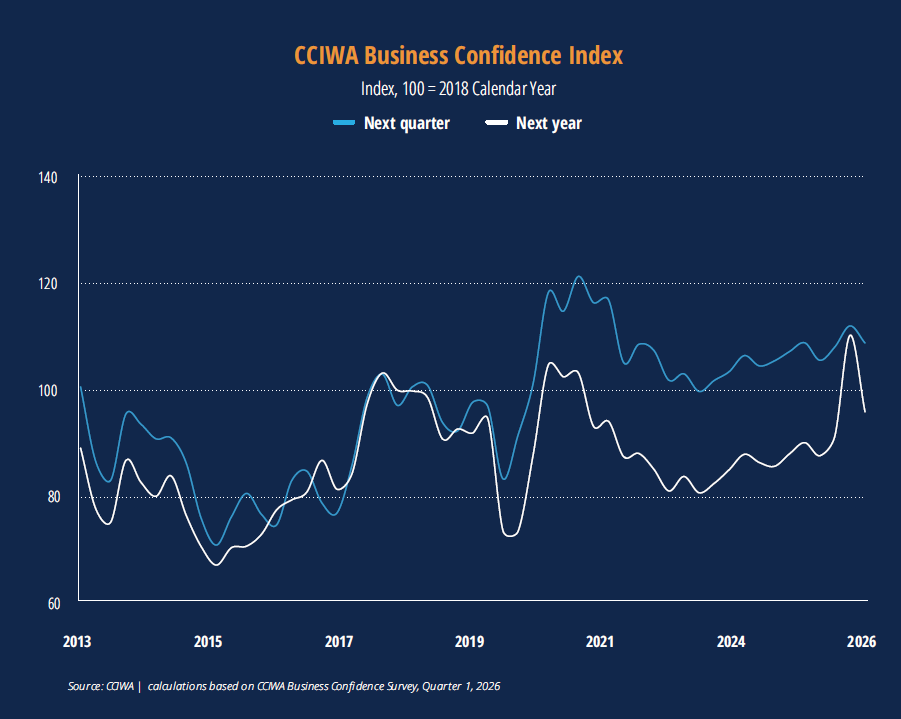
“WA businesses were struggling with cost pressures before this conflict started, so we’re coming into the crisis in an environment where business confidence was already going down,” Kiely said.
“We expect confidence to take a further hit as a result of the conflict, driven by the increased cost of fuel, which impacts virtually every business in some way,” he said.
Kiely said there were supply chain concerns for sectors such as agriculture, which relied on the Strait of Hormuz to transport goods including fertilisers and petrochemicals.
“Aside from those direct impacts, businesses in WA can expect all other inputs to increase in line with inflation,” he said.
Costs surge as key barrier to growth
Rising costs remained a key challenge for WA businesses, with 68% identifying it as a major barrier to growth – up 16 percentage points since December.
More than four in five (81%) businesses said wages were the biggest cost pressure, followed by insurance (55%) and government charges (40%).
“Businesses are being squeezed from every direction, and payroll tax is one area the State Government has the power to do something about,” Kiely said.
“When you consider payroll tax kicks in at a $1 million annual wages bill, it’s capturing more small and medium-sized businesses than ever thanks to rising labour costs.”
Labour shortages remain the biggest constraint
Nearly 69% of businesses were having difficulty finding workers, especially in construction (82%), agriculture (81%) and resources (76%).
Kiely said the WA employment market was “extremely tight”, with the 3.4% unemployment rate the lowest in the nation.
“It’s vital that both the State and Federal Governments make skills training a priority and take a longer-term approach to ensuring there’s a pipeline of workers for WA industries,” he said.
“Federal incentives for employers who take on apprentices and trainees have been slashed, and we’ve seen an overall decline in the number of people starting apprenticeships and traineeships.”
CCIWA’s Economic reports are available exclusively to CCIWA Complete, Advantage and Corporate Members. For more, see CCIWA’s Economic Insight page.