



Artificial intelligence (AI) has not yet caused widespread job losses in Australia but employment growth is slowing in occupations most exposed to automation, a new Federal Government report finds.

“The report reveals that artificial intelligence is not currently causing upheaval in the labour market,” Employment and Workplace Relations Minister Amanda Rishworth said.
“AI is changing how we work, but it also has real potential to lift productivity, build skills and create new opportunities.”
It estimated AI’s impact on the workforce was “modest … much smaller than public claims that AI is already producing large-scale job loss”.
AI-exposed occupations grow slower
Despite the broader labour market’s resilience, the report identified early signs of softer conditions in occupations with greater potential for AI automation.
Between November 2022 and February 2026, employment in the most AI-exposed occupations grew by 5.6%, compared with 9.5% for those least exposed.
Highly exposed occupations also recorded slower growth in hours worked, larger falls in job advertisements and a greater rise in unemployment.
The most-exposed occupations are generally cognitive roles involving routine, predictable tasks.
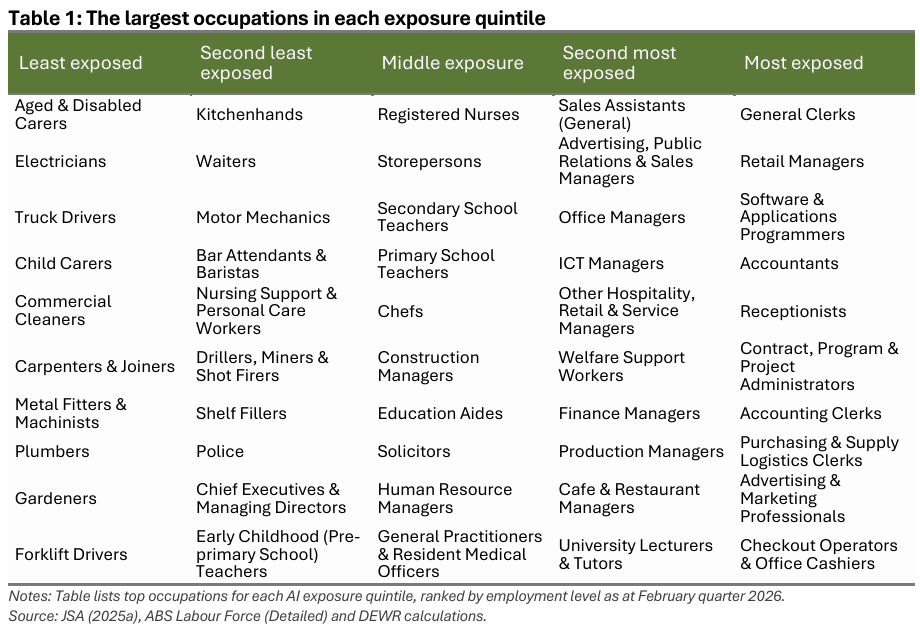
“The evidence is an early indication of some modest slowing in employment growth in some highly exposed occupations, not proof of large AI-driven job loss,” the report stated.
Many routine clerical and administrative roles were already declining AI’s big uptake, making it difficult to separate AI’s potential impact from longer-term workforce trends.
Productivity gains lead to new jobs or job losses? Not yet known
AI could reduce employment by automating tasks but also create jobs by lifting productivity and generating new types of work. The report classified the net impact into:
- Displacement: businesses substitute technology for human work, putting people out of work.
- Productivity: automation increases the amount or quality (known as augmentation) of work someone can produce, leading to more productivity and increases the demand for labour in non-automated tasks.
- Reinstatement: technology creates new tasks that gives humans a comparative advantage, often leading to new tasks or jobs that previously didn’t exist.
“If we do not see job displacement from AI, this would mean the reinstatement and productivity effects have outweighed displacement,” the report said.
“This could occur if AI has been used more to augment rather than automate tasks.”
Graduate employment remains resilient
Young and graduate workers are some of the most AI-exposed people in the workforce, as when economic conditions change employers tend to retain existing staff and hire less – which affects younger workers more. Also, large language models (LLMs) are trained on academic knowledge, rather than on-the -job experience, making AI more likely to substitute junior workers over senior staff.
But the report showed little evidence of that occurring in practice.
Employment among people aged 20 to 24 grew slightly faster than employment among people aged 25 and over since November 2022.
The unemployment rate for graduates aged 20 to 24 was 5.4% in February 2026, the lowest point in the five years before COVID.
The report only examined demographics by age but mentioned that women were “thought to be susceptible to automation” due to being disproportionately employed in exposed occupations.
What’s next?
The report said continued monitoring and more data was needed to understand the net effect of AI on employment.
Want to keep up to-date with the latest business news and advice? Become a CCIWA Member today and get access to exclusive information and services designed to help you do business better. Find out more here.