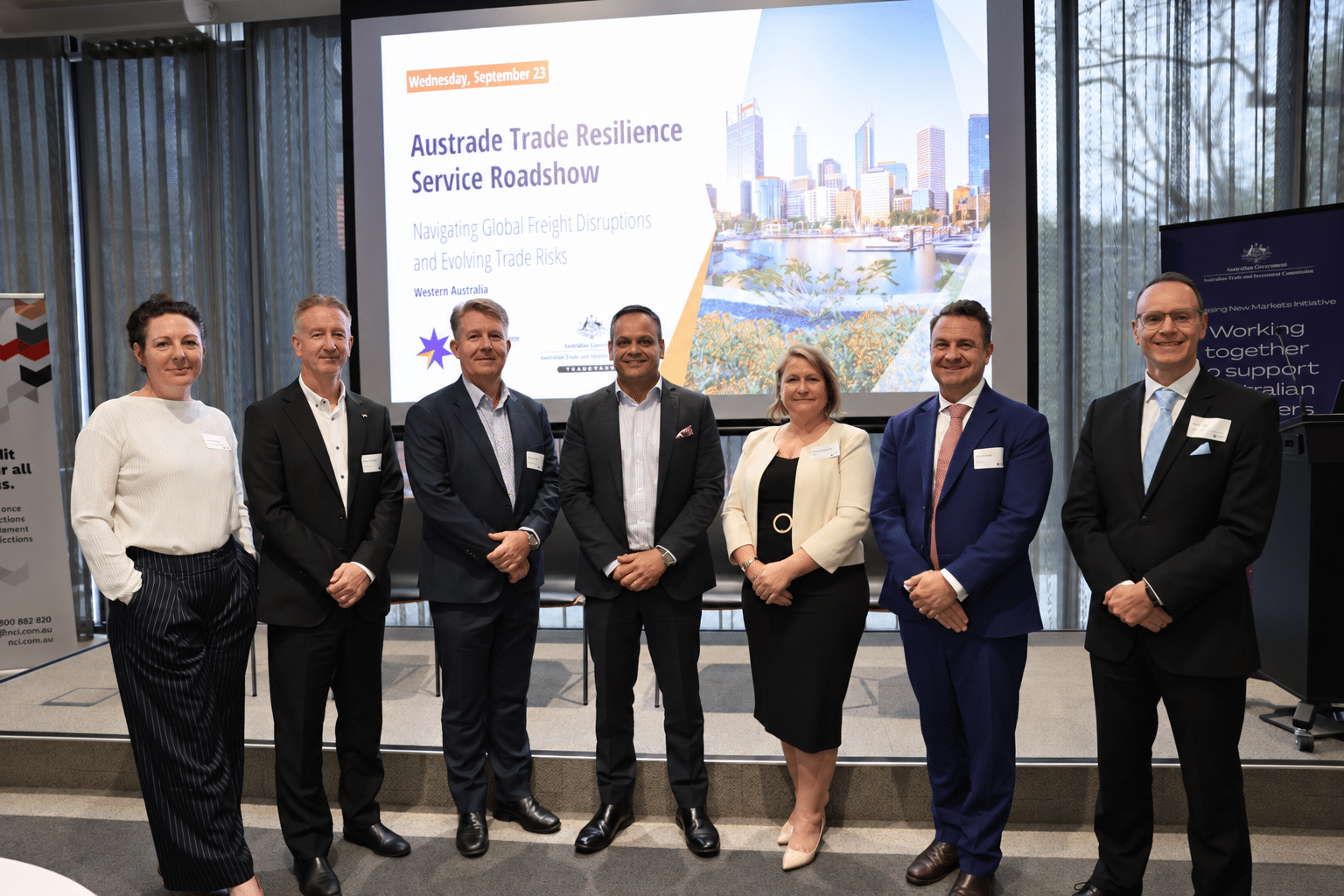



At a time when exporters are dealing with tighter fuel markets, more frequent supply shocks and a faster‑moving technology cycle, the conversation between former Australian foreign minister Julie Bishop and Canadian Consul General Ghislain Robechaud delivered a clear message: trade is no longer “just trade”.
It is increasingly shaped by national security, alliance settings and economic coercion.
“Treat geopolitical intelligence as importantly as you treat your bottom line,” Bishop told the GRX26 conference in Perth.

She said the “blockade of the Strait of Hormuz” has made visible what has been building for years: that disruption can quickly move from geopolitics into prices, procurement and project delivery.
The implications for business are immediate. The diplomatic environment that once allowed companies to focus on “geology, engineering, technology, commodity prices, workforce” has shifted. “That era is over,” Bishop said.
Describing the “new diplomatic landscape”, Bishop said global trade was being reshaped by three forces: a weakening rules‑based order, the weaponisation of resources in geopolitical disputes, and a technology‑driven surge in demand for critical minerals.
“Resource diplomacy used to be trade diplomacy. Today, it is inextricably tied to national security diplomacy,” she said.
“In trade talks, we used to focus on market access and tariff schedules and the like, but now it’s supply chain resilience, strategic stockpiling and the importance of trusted, reliable, long‑term partners.
“Mines and processing facilities and transport infrastructure are now viewed as assets in a strategic calculation that extends well beyond a company’s balance sheet.
“Governments will ask you to take sides, not implicitly, explicitly, and will have views about where companies invest and with whom you partner.”
Bishop’s “new rules of resource diplomacy” were direct and commercially relevant.
- One: “Geopolitical risk is operational risk.”
- Two: “The source of capital matters as much as its cost.” In other words, the identity of investors, joint venture partners and offtake customers can shape approval pathways and market access — not just the numbers in a deal.
- Three: “Community and country relationships are now strategic assets.”
- Four: “Transparency is a competitive advantage.”
- Five: “Industry needs a seat at the diplomatic table.”
From Canada’s perspective, Robechaud reinforced the same shift, focusing on the need for diversification.
“We just have to realise that we can’t go back… We have to diversify the market. We have to diversify the supply chain,” he said.
He captured Canada’s sensitivity to US policy settings with a line that will resonate with exporters: “When the elephant sneezed, we catch the cold in Canada.”
The broader takeaway for Australian businesses is clear: allied partners are moving quickly to build alternative markets and supply chains. Waiting for “normal” to return is not a strategy.
The discussion also highlighted an opportunity: deeper Australia–Canada collaboration, not as adversaries but as complementary suppliers.
“I don’t want anybody to think that Canada and Australia are competitors. We are, but it’s not adversarial. Competition makes us better,” she said.
This means greater collaboration on “processing and downstream processing” to reduce reliance on chokepoints and build “integrated, allied ecosystems”.
“If you’re not at the table, you’re on the menu,” Robechaud said.
If you are looking for support or advice in business, investment or trade, contact our experienced International Trade Services team at [email protected].