




Businesses are increasingly using artificial intelligence (AI) to review workplace policies and documents – and while it’s convenient, the legal risks can be significant.
It is common for businesses to request lawyers to review workplace policies, procedures, codes of conduct and contracts; many which may be generated via AI.
On the surface, these documents look to meet the key requirements of a workplace policy. However, a closer look shows major gaps. And, even worse, can mean businesses are not meeting their legal obligations or inadvertently breaching them.
AI appears to have the capability to provide what looks to be a solution; a succinct, easy-to-understand, effective document that took all of 30 seconds.
But in reality, the document likely has legal compliance issues that, if the policy drafter is not careful, may not be enforceable in the workplace.
Let’s see it in practice
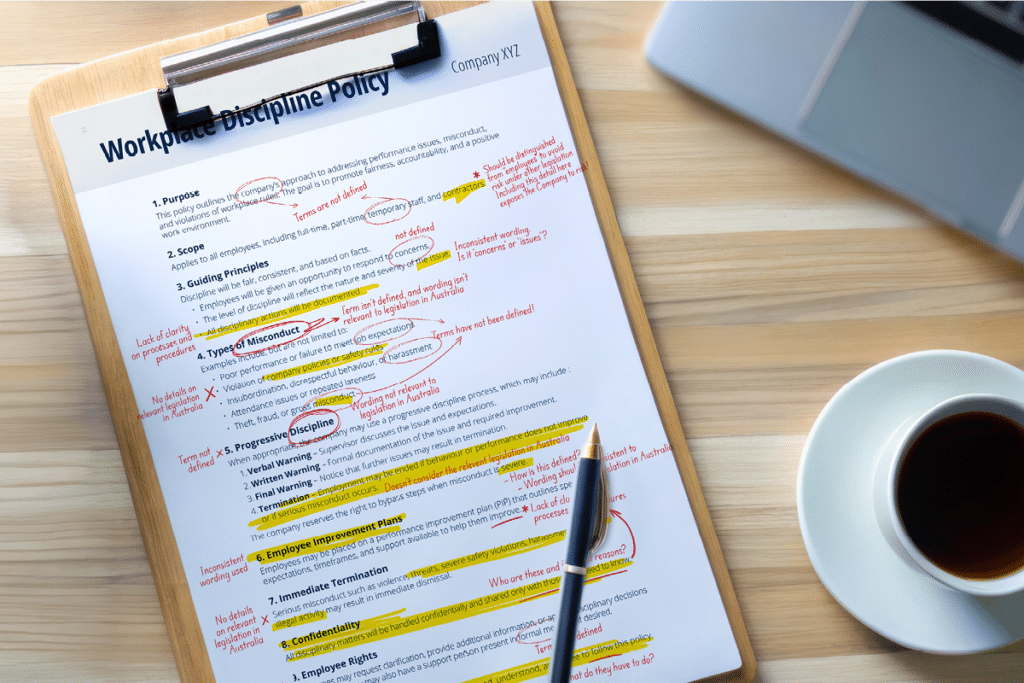
Business Law WA (BLWA) recently conducted an exercise asking Chat-GPT, a common AI platform, to create a workplace disciplinary policy.
BLWA then did an Employment Contracts and HR Document Review of the AI-generated policy.
The key issues identified were:
- Inconsistent wording throughout the policy
- Terms being used that were not clearly defined
- Lack of clarity on processes and procedures
- Restrictions on the employer which meant they could not act flexibly
- No details on relevant legislation in Australia
- Expansive application to non-employees which might cause significant other issues, including with independent contractors being found to be employees
Employment Contracts and HR Document Review
BLWA currently offers CCIWA Members three complimentary reviews of a contract of employment or internal workplace policy (the terms of which can be accessed here).
If you would like to access this service, please contact [email protected] for more information.
Why AI misses the mark on drafting legal documents
Generative AI tools do not have the capability to be able to interpret complex information, such as legislation or case law.
Where workplace policies and contracts must meet certain requirements under, for example, the Fair Work Act 2009 (Cth), it is unlikely a generative-AI drafted policy or contract would suffice.
Alarmingly, BLWA commonly sees AI referencing case law that does not exist. This ‘invented’ case law often looks and feels realistic: it sets out a background, judgement and reasoning. It often cites legislation that is not based on Australian law.
Businesses may also be in breach of privacy laws if personal or sensitive information is put into generative-AI software. This could include names, dates of birth, positions within companies, health information, salaries and other information. Users often do not realise the information they are sharing breaches their privacy obligations and puts them at compliance risk.
Key takeaways
AI is not a suitable replacement for critical thinking and expert oversight – especially in business.
It does not know the intricacies of a business, nor does it understand what is required for a policy to meet legal obligations.
AI should be used as a tool, but it cannot be trusted or relied upon alone to create workplace documents that are suitable for the needs of the business and compliant with legislative requirements.
If you'd like to speak to an employment lawyer about your workplace policies or other documents, please contact Business Law WA via [email protected] or on 08 9365 7560.
Related reading
- ChatGPT at centre of unfair dismissal case
- Employment contracts – Business Law WA answers common questions
Workplace training
- Introduction to Employment Law: Providing HR professionals the knowledge to navigate employment law, meet obligations and minimise legal risk.
- Industrial Relations Masterclass: Expert-led, five-day immersive program designed to elevate mid- to senior-level IR skills through practical workshops, real-world insights and a tailored IR briefing.
This article is authorised by Business Law WA, an incorporated legal practice and wholly owned subsidiary of CCIWA. The content of this article is general in nature and is not legal or professional advice and should not be relied upon as such.